
Blockchain has evolved from a buzzword tied to cryptocurrencies into one of the most transformative technologies across industries. Whether you’re in finance, supply chain, or software development, blockchain offers new ways to ensure transparency, traceability, and security in data exchange.What Is
Blockchain?
At its core, blockchain is a distributed digital ledger that records transactions across many computers. Each record—called a block—contains data, a timestamp, and a cryptographic hash linking it to the previous block, forming an unbreakable chain.
Unlike traditional databases managed by a central authority, a blockchain is decentralized: all participants hold identical copies of the ledger. Once data is recorded, it cannot be altered without consensus, ensuring integrity and trust.
Key Features
- Decentralization – No central entity controls the network; everyone shares equal authority.
- Transparency – Transactions are visible to all authorized participants.
- Immutability – Data recorded on the blockchain cannot be modified or deleted.
- Security – Advanced cryptographic algorithms protect data from tampering.
- Smart Contracts – Self-executing agreements that trigger automatically when predefined conditions are met.
Beyond Cryptocurrency
While Bitcoin introduced blockchain to the world, its potential goes far beyond digital currency. Today, the technology powers applications in:
- Finance (DeFi) – Peer-to-peer lending, decentralized exchanges, and stablecoins.
- Supply Chain Management – Real-time tracking of goods and verification of authenticity.
- Healthcare – Secure patient data exchange and medical record transparency.
- Voting Systems – Tamper-proof digital voting for enhanced democratic trust.
- Intellectual Property – Protecting ownership through verifiable timestamps.
How Blockchain Works – Step by Step
- Transaction Initiation: A user initiates a transaction (e.g., sending digital assets).
- Validation: The network verifies it through consensus algorithms like Proof of Work (PoW) or Proof of Stake (PoS).
- Block Creation: Once validated, the transaction is grouped with others into a block.
- Block Linking: The new block is added to the existing chain, secured via cryptography.
- Distribution: The updated blockchain is broadcast to all participants.
Because each block references the one before it, altering a single transaction would require changing every subsequent block—an almost impossible task without the consensus of the entire network.
Tutorial: Building a Simple Blockchain in Python
Let’s explore a mini example to understand the mechanics behind blockchain.
Step 1 — Create the Block Structure
import hashlib
import time

class Block:
    def __init__(self, index, data, previous_hash):
        self.index = index
        self.timestamp = time.time()
        self.data = data
        self.previous_hash = previous_hash
        self.hash = self.calculate_hash()

    def calculate_hash(self):
        value = str(self.index) + str(self.timestamp) + self.data + self.previous_hash
        return hashlib.sha256(value.encode()).hexdigest()
Step 2 — Create the Blockchain
class Blockchain:
    def __init__(self):
        self.chain = [self.create_genesis_block()]

    def create_genesis_block(self):
        return Block(0, "Genesis Block", "0")

    def get_latest_block(self):
        return self.chain[-1]

    def add_block(self, data):
        previous = self.get_latest_block()
        new_block = Block(len(self.chain), data, previous.hash)
        self.chain.append(new_block)
Step 3 — Add and Display Blocks
my_chain = Blockchain()
my_chain.add_block("Transaction 1: Mahmoud sends 2 BTC to Ali")
my_chain.add_block("Transaction 2: Ali sends 1 BTC to Sara")

for block in my_chain.chain:
    print(f"Index: {block.index}, Data: {block.data}, Hash: {block.hash[:20]}...")
Run this script, and you’ll see each block linked securely with its predecessor—demonstrating how integrity is maintained through hashes.
Blockchain in the Real World
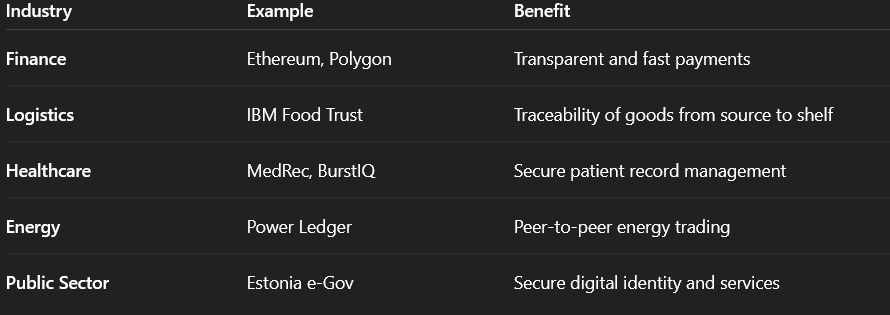
These use cases highlight blockchain’s role in building digital trust—one of the most valuable currencies of our era.
Challenges & Future Outlook
Despite its promise, blockchain faces hurdles:
- Scalability: Current systems struggle to process large transaction volumes.
- Energy Consumption: Proof-of-Work blockchains consume significant power.
- Regulation: Governments are still defining frameworks for blockchain use.
Yet, progress continues. Emerging innovations such as Layer-2 scaling, Zero-Knowledge Proofs, and Green Consensus (energy-efficient mechanisms) aim to solve these challenges and pave the way for broader adoption.
Conclusion
Blockchain is more than a trend—it’s a paradigm shift in how data, value, and trust are managed digitally. Developers who understand its principles can help shape the future of decentralized systems, from finance to logistics and beyond.
So, whether you’re a coder, entrepreneur, or analyst, now is the time to experiment, build, and learn—because the blockchain revolution is just getting started.