
Behind every successful web application lies a reliable database. Whether it’s managing user accounts, handling transactions, or storing product catalogs, the database you choose will directly impact your project’s performance, scalability, and long-term growth. With so many options available, developers often struggle to decide which database is the best fit. In this post, we’ll take a closer look at the most popular databases in 2025, compare their strengths and weaknesses, and summarize the results in a benchmark table.
1. MySQL
MySQL remains one of the most widely used databases in the world. Known for its reliability, speed, and ease of use, it has been the backbone of countless web applications for over two decades. Its integration with popular web technologies like PHP and frameworks such as Laravel and WordPress makes it a go-to option for many developers.
However, while MySQL performs extremely well in small to medium-sized applications, it lacks some advanced features found in more modern systems, such as complex query handling and advanced indexing. For projects that don’t require heavy customization, MySQL is still an excellent and beginner-friendly choice.
2. PostgreSQL
Often referred to as the most advanced open-source relational database, PostgreSQL is praised for its strict adherence to ACID principles and support for complex queries. It offers features like JSON storage, full-text search, and GIS (Geographic Information System) capabilities, making it extremely versatile.
Enterprises and large-scale applications often prefer PostgreSQL because of its ability to handle massive amounts of data while maintaining performance and accuracy. The main downside is its steeper learning curve compared to MySQL, but once mastered, it provides unmatched flexibility and reliability for demanding projects.
3. SQLite
SQLite is a lightweight, file-based database engine that requires almost no configuration. Unlike server-based databases, it stores all data in a single file, which makes it incredibly easy to set up and distribute. Developers often use it in mobile applications, embedded systems, or small web projects that don’t require heavy concurrency.
Its simplicity, however, comes at a cost. SQLite isn’t designed for large-scale applications or projects with high traffic. When multiple users try to write data simultaneously, performance issues may arise. That said, for prototyping, small tools, or offline-first apps, SQLite is hard to beat.
4. MongoDB
MongoDB represents a different approach to data storage. As a NoSQL database, it doesn’t use tables and rows but instead stores data in flexible, JSON-like documents. This makes it ideal for projects with dynamic or unstructured data, such as content management systems, IoT platforms, or applications with rapidly changing requirements.
The main advantage of MongoDB is scalability. It’s designed to scale horizontally across clusters, which makes it perfect for big data and real-time analytics. On the flip side, MongoDB is less suited for applications requiring strict transaction support. Still, for modern web apps that prioritize speed and adaptability, MongoDB is a strong contender.
5. MariaDB
MariaDB was created as a fork of MySQL when concerns about Oracle’s acquisition of MySQL arose. Since then, it has grown into a powerful database in its own right. MariaDB offers performance improvements, new storage engines, and backward compatibility with MySQL, making migration seamless.
Developers appreciate MariaDB for its open-source commitment and its ability to outperform MySQL in certain workloads. However, its ecosystem is smaller, and some tools still focus more on MySQL support. For teams that want the familiarity of MySQL but with additional flexibility and performance, MariaDB is an excellent choice.
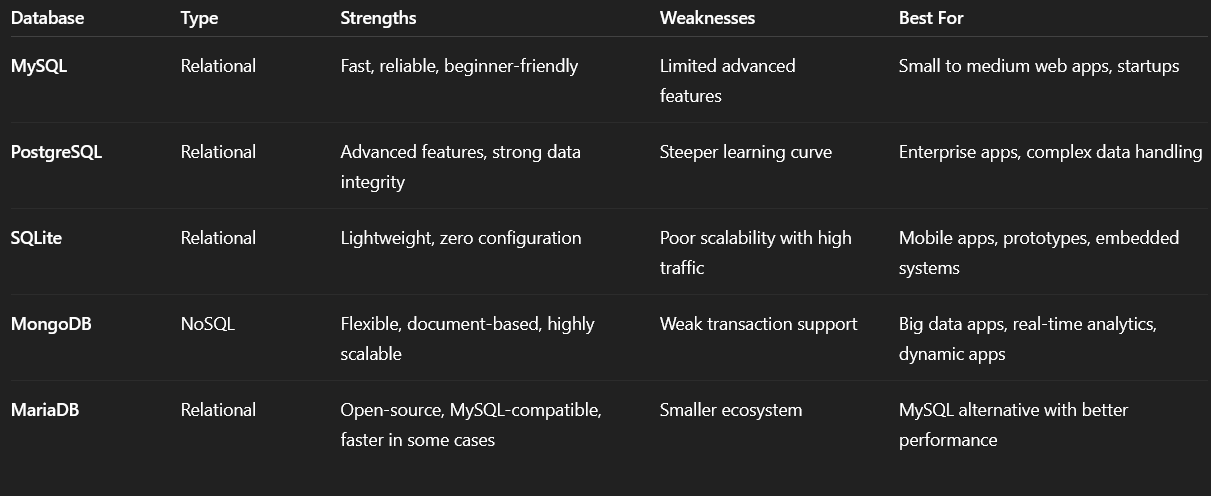
Recap Table: Best Databases for Web Applications
Conclusion
Selecting the right database depends entirely on your project’s requirements. MySQL remains a solid choice for traditional web apps and startups thanks to its reliability and ease of use. PostgreSQL is the powerhouse for enterprises and data-heavy applications. SQLite is unbeatable for lightweight and mobile use cases, while MongoDB shines in handling unstructured data and scaling across massive datasets. Finally, MariaDB provides an improved, open-source alternative to MySQL for developers seeking more flexibility.
In short: if you’re building a small project, start with MySQL or SQLite. If you’re scaling a complex system, consider PostgreSQL or MongoDB. For a balance between familiarity and performance, MariaDB is worth a closer look.